
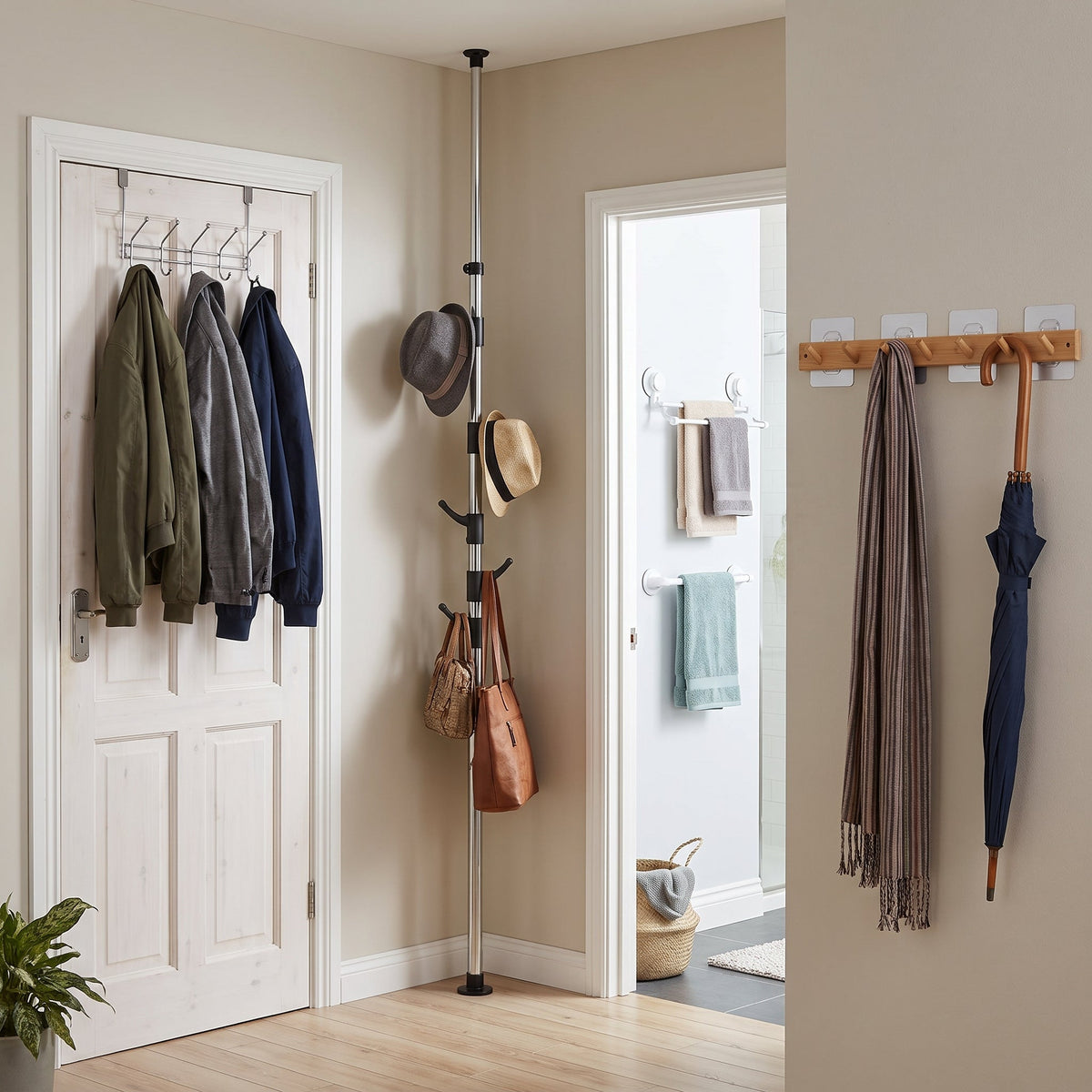
When renting, living in a new home, or simply wanting to avoid damaging a freshly painted wall, drilling is not always an option. A no-drill coat rack meets this specific need, but four product families share the label, and they are not all equal. Each has a real weight limit, a required surface, and a use case where it fails. Here is how to tell them apart before ordering.
Adhesive or magnetic no-drill coat racks
A quality adhesive hook can hold a few kilos, which is enough for a jacket, handbag, or scarf. Its success depends almost entirely on the preparation of the surface: it must be smooth, non-porous, degreased, and dry. Tiles, lacquered doors, mirrors, or glass are perfectly suitable. Matte paint, wallpaper, or plastered walls will not hold anything permanently.
Two mistakes cause the vast majority of installations to fail. The first is loading the hook as soon as it is applied, whereas most adhesives require several hours before reaching maximum adhesion. The second is installing an adhesive no-drill coat rack in the bathroom without checking its resistance to moisture: steam peels off ordinary adhesives in a few weeks.
The magnetic version meets the same need with a different constraint. On any ferromagnetic surface, metal door, radiator, refrigerator, or steel structure, it can be installed in seconds, repositioned at will, and leaves no trace. Its holding strength is expressed in kilos distributed between the hooks, and it is the only family that allows for mistakes: if misplaced, it can be moved ten centimeters without consequence. A refrigerator magnet is enough to check that the surface is suitable.
The over-the-door model and the freestanding coat rack
The over-the-door model hooks over the door leaf without any fasteners or glue. It is the most reliable solution when the wall is completely ruled out, and the most discreet of all: the coat rack disappears behind the open door and is no longer visible from the room. Two points need to be checked before ordering: the thickness of the door leaf, as these models are designed for a specific range, and the presence of a seal or molding at the top of the door that sometimes prevents flat installation.
The freestanding coat rack, meanwhile, depends on no wall, no surface, and no glue. It is the only family that accepts several winter coats without question, even wet ones, because its capacity lies in its base rather than on an external support. In return, it takes up between thirty and fifty centimeters of floor space, which rules out the narrowest hallways.
This option is also the one to choose when the partition is in poor condition, when renovations are planned, or when you move frequently: a freestanding coat rack can be moved by hand and reassembled elsewhere without leaving anything behind.
Which no-drill coat rack to choose according to your home
On a smooth surface and for a light load, adhesive remains the simplest: a few hooks near the front door can hold everyday jackets and bags. It is the format that takes up the least space and requires the least commitment, provided you accept its weight limit.
When faced with a metal surface, the magnetic version takes the lead without hesitation, because it combines the quick installation of adhesive with complete reversibility. In a studio where the front door is metal, or along a sheet metal radiator, it provides a hanging point without any preparation.
If no wall is available, the over-the-door model becomes the default answer, and for several winter coats, the freestanding model is the only choice. All our no-drill models are grouped in the same place, with the installation method indicated on each product page.
One final point that often sets these four families apart: reversibility. The magnetic and freestanding models can be removed without leaving any trace, an over-the-door installation leaves at most a friction mark on the edge of the door leaf, while an adhesive removed without care can tear off the paint. When renting, this difference matters more than a few kilos of capacity.
Choosing a no-drill coat rack therefore means starting with the available surface rather than the product: a smooth surface calls for adhesive, a metal surface for magnetic, a door for the over-the-door model, and a total lack of hanging point for a freestanding model, the only one capable of holding several winter coats.
Word count: 744

